




Information Center
Time:2026-04-22 14:32:44 Hits:
According to industry statistics, up to 80% of sidewall conveyor belt failures occur due to rigidity loss–induced sagging during operation. QBF rubberaddresses this root cause with an innovative "free zone " base belt design, significantly extending the service life of sidewall conveyor belts.
Under heavy load, especially on the return run, the base belt often sags due to insufficient transverse rigidity. This sagging triggers a chain of serious issues:
Stress concentration – Sagging causes abnormal flexing at the sidewall root as it passes over the drum, concentrating stress in a localized area.
Fatigue cracking – Repeated flexing leads to fatigue cracks at the sidewall root, which can develop into through-wall damage.
Baffle detachment – Vibration and deformation from sagging transfer to the baffle connection, accelerating adhesive aging and causing baffle loosening or separation.
Once sidewall tearing or baffle detachment occurs, the entire sidewall conveyor belt often fails prematurely. Therefore, solving the sagging problem is the key to extending belt service life.
The core cause of sagging lies in structural deficiencies of traditional base belt designs:
Insufficient transverse rigidity – Traditional base belts cannot maintain a flat profile under heavy loads or long-span conditions.
Unbuffered stress transfer – The sidewall-to-base belt connection lacks a flexible transition, so abnormal sagging stress directly impacts the sidewall root.
Accelerated fatigue accumulation – Repeated flexing at stress concentration points causes cracks to grow from micro to macro levels.
Understanding these causes makes it clear: simply increasing sidewall thickness or changing the rubber compound is a temporary fix. The solution must start with the base belt structure.
QBF rubber introduces a "free zone " base belt design to directly target the root cause of sagging.
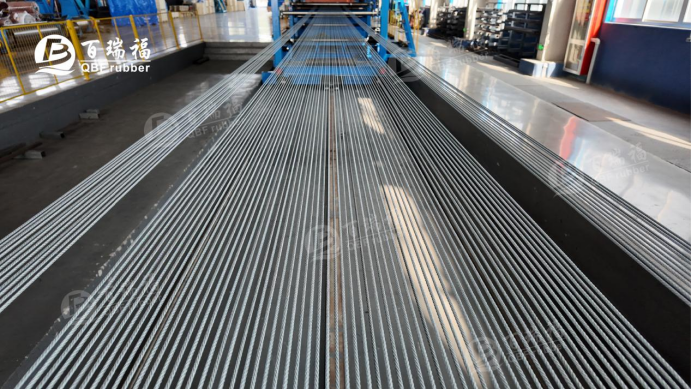
Blocks stress transfer – The free zone acts as a stress buffer, absorbing and isolating abnormal sagging stress before it reaches the sidewall root.
Dissipates flexing energy – The flexible edge allows the base belt to adaptively deform as it passes over the drum, spreading concentrated flexing over a larger area.
Protects sidewall and baffles – By mitigating the extra load caused by sagging, the risk of fatigue tearing at the sidewall root is greatly reduced, and the baffle adhesive layer no longer suffers excessive vibration stress.
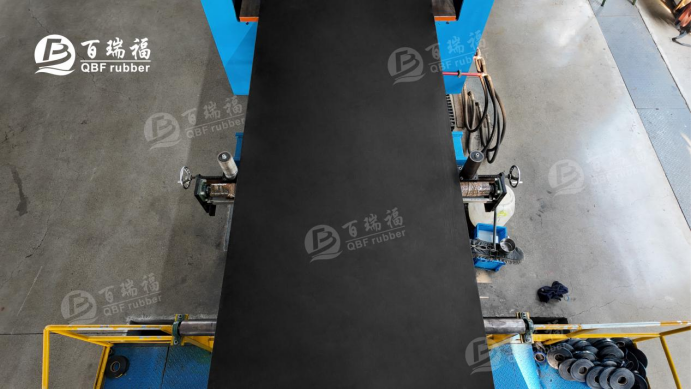
Advantage | Result |
sidewall tear resistance | Eliminates stress concentration points; fatigue life extended by 2–3 times |
Baffle detachment risk | Smoother operation; significantly slower adhesive aging |
Overall belt service life | Comprehensive service life increased by 30% or more |
QBF rubber's Free Zone Base Belt design achieves a leap from "reacting to sagging consequences" to "eliminating the root cause of sagging."
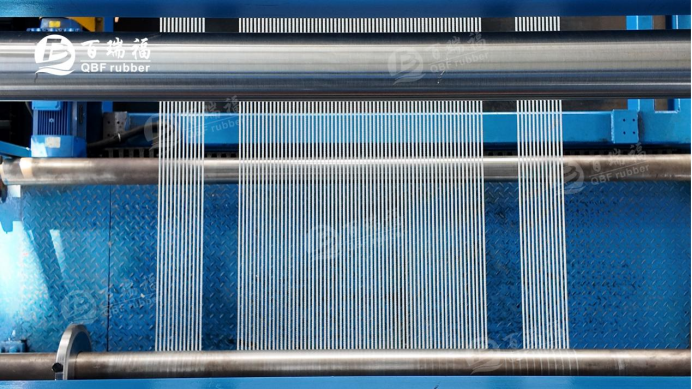
The sagging problem in heavy-duty sidewall conveyor belts originates in the base belt structure. QBF rubber's free zone design solves this industry pain point by blocking stress transfer, dissipating flexing energy, and protecting both sidewall and baffles.
If you are experiencing frequent sagging, sidewall tearing, or baffle detachment with your sidewall conveyor belt, contact QBF rubber for professional technical support and customized solutions.
*Please fill in the required information carefully, and we will contact you within 24 hours.

Professional brand of European standard long-life side guard belt
Expert in low-carbon intelligent transportation services for bulk materials
Copyright © 2023-2024 QBF All rights reserved Record number:鲁ICP备12028203号-1
Technical support: WDL